Luxury Bungalow Design in Ahmedabad: What Eight High-End Homes Taught Us
25-06-2026

Ahmedabad has changed a lot in the last decade. Bopal, Shela, SG Highway, and South Bopal were mostly open land fifteen years ago. Today they're lined with bungalows that look nothing like the boxy G+1 structures from a generation back. People want more from their homes now: better light, better ventilation, and spaces that actually fit how the family lives rather than how many bedrooms a brochure can list.
At Architects at Work, luxury bungalow design in Ahmedabad is the only kind of work we take on. We don't do compact or entry-level builds, and we don't treat architecture and interiors as two separate jobs either. Whether a client comes looking for bungalow architects in Ahmedabad or specifically a bungalow interior designer in Ahmedabad, our process treats both as one continuous, fully custom design problem from the first sketch to the last cupboard handle. Our projects range from an intimate 600-yard plot designed without a single shortcut to a sprawling 13,000 sq. ft. estate, and across all of them, a few patterns keep showing up. This post walks through some of our recent high-end projects and what they reveal about designing a luxury bungalow that actually works for Ahmedabad's climate, culture, and the way affluent families here live.
Why Bungalow Design in Ahmedabad Is Trickier Than It Looks
Ahmedabad's summers are brutal. Anyone who has lived through a May afternoon here knows orientation isn't a design footnote, it's survival. A bungalow that faces the wrong way bakes in the afternoon sun for months. So before anything else, our team starts with the plot itself: which side is north, where the neighbours' walls block or open up views, which direction the prevailing wind comes from.
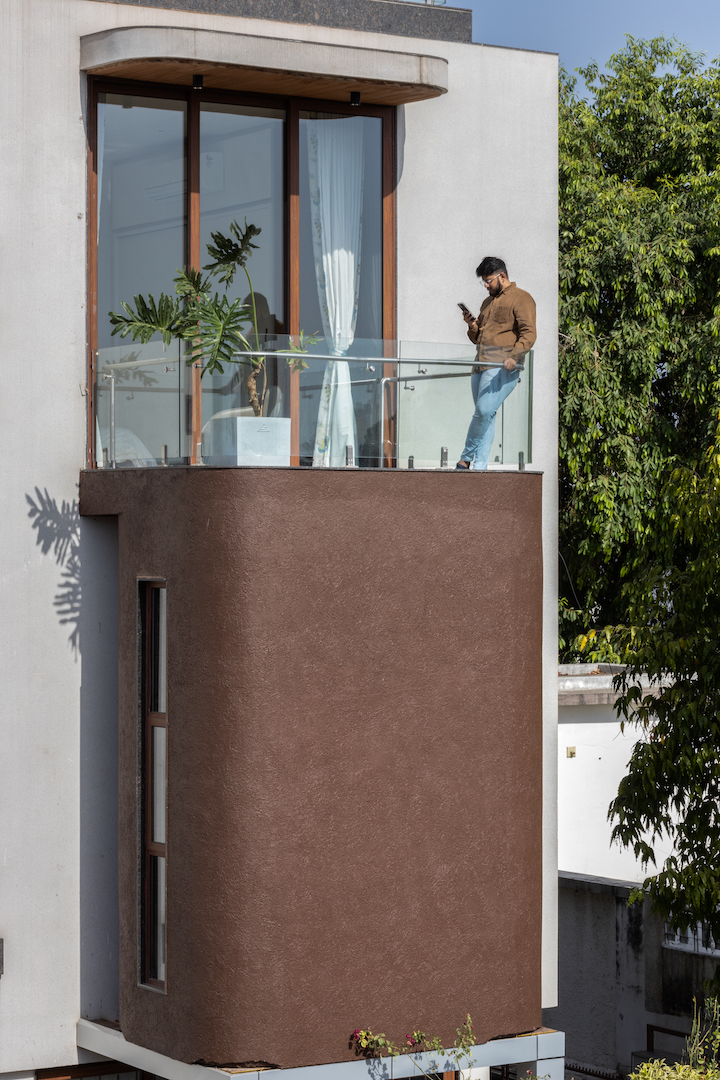
Add to that the cultural layer. Most of our clients are joint families, or families that want flexibility for parents to move in later. Vastu still matters to a large share of homeowners here, whether they're devout about it or just want to avoid arguments at family gatherings. And then there's the simple fact that a bungalow in Ahmedabad isn't only a private home, it's also a statement to the street. Elevation matters in a way that's hard to explain unless you've walked through Bopal or Satellite and noticed how much variety there is in the facades there.
These pressures don't always point in the same direction. Good light wants big windows. Good thermal comfort sometimes wants the opposite. That tension is basically the whole job.
31 Dagli's: Designing for Seven People Under One Roof
31 Dagli's sits on a north-facing plot along the busy Ambli Road, hemmed in by neighbouring bungalows on three sides. It was designed for a joint family of seven, and the brief was less about square footage and more about giving each person a sense of their own space inside a shared home.
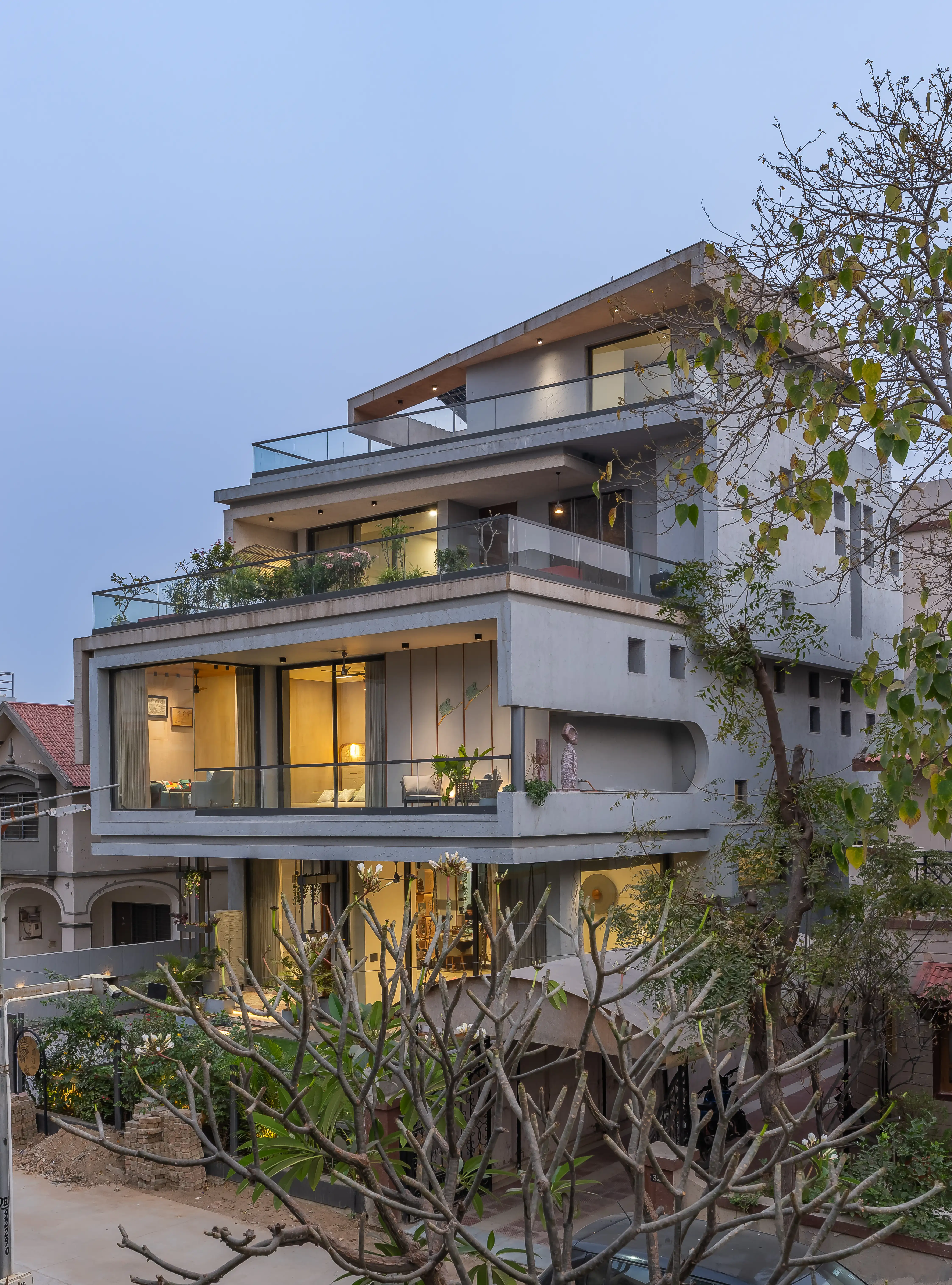
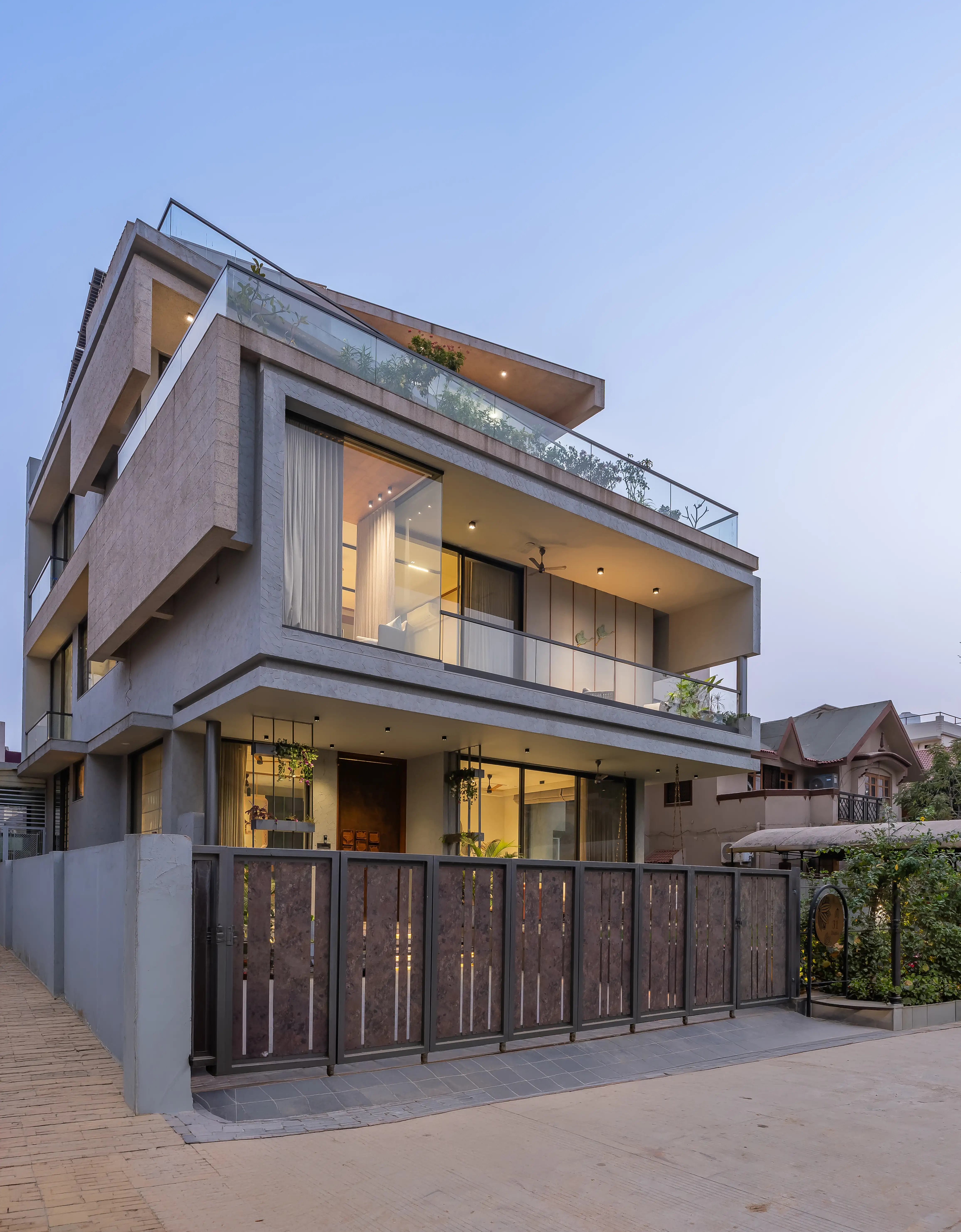
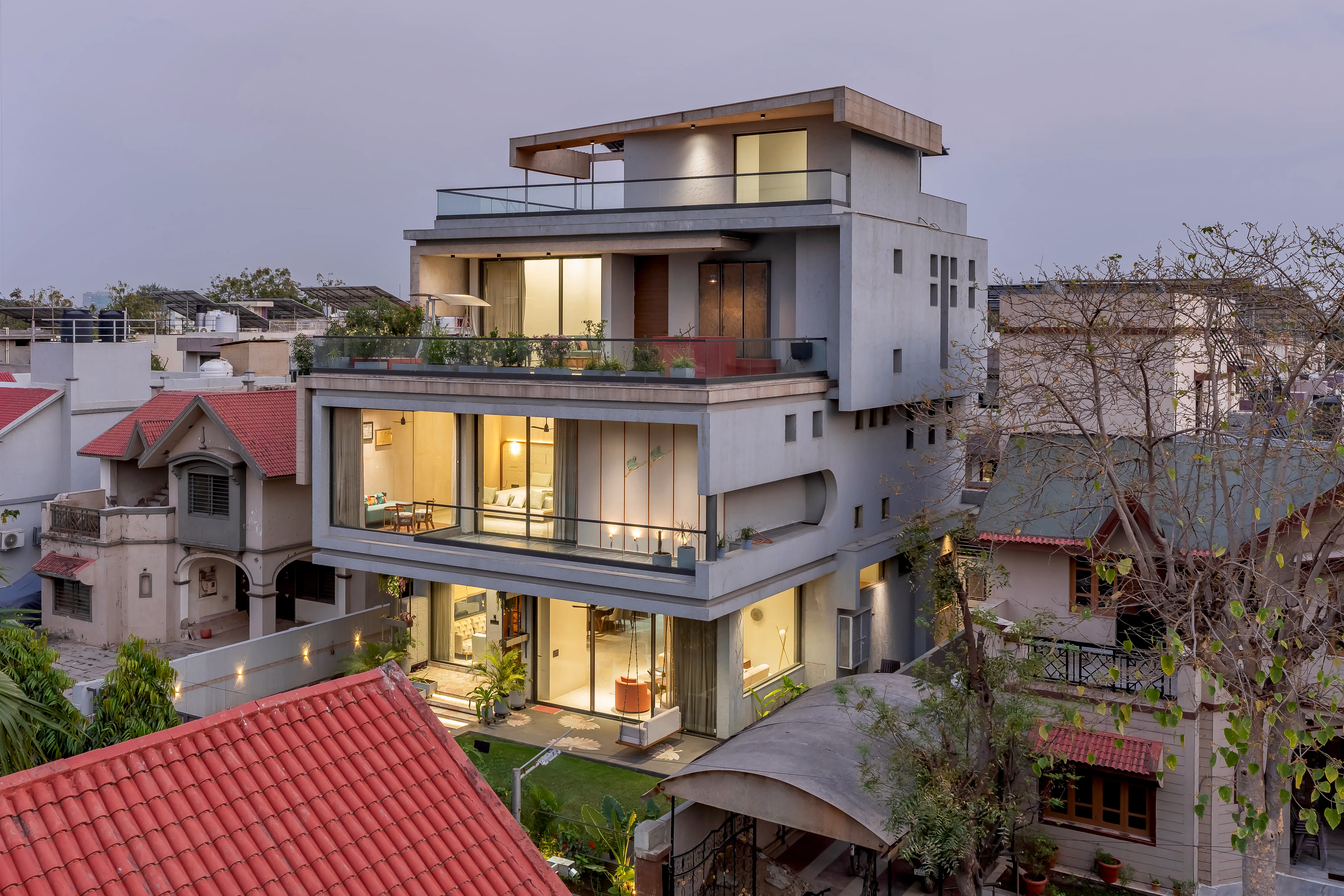
We opened the main living areas toward the north garden so the family gets daylight without the late-afternoon heat. Bedrooms sit along the north and east, while dressing areas and toilets were pushed to the west, acting as a thermal buffer against the harsh western sun. A jharokha-style seating bay, raised on a wooden deck with a full-height glass front, turns the front room into something between an interior space and a balcony.
What stands out most in this one is how different the two younger bedrooms feel from each other despite sitting in the same house. One leans grey and industrial, with CNC-textured panelling and bold blue furniture. The other is playful, with wave-pattern wall panelling, a swing, and brighter colours. The dining area doubles as the spiritual centre of the house, with a carved metal temple motif that repeats in the floor inlays of the veranda and terrace. Even the entrance has a sequence to it: floating pink marble steps, natural boulders, and a rusted liquid-metal door with a sculptural handle.
The Concrete Tree: Proof That Less Detailing Can Be the Harder Choice
Not every client wants drama. The Concrete Tree, a 6,660 sq. ft. home built for Ashwinbhai Patel, was the opposite brief. The client wanted a sanctuary rather than a showpiece, with no ostentation, just calm and well-proportioned rooms.
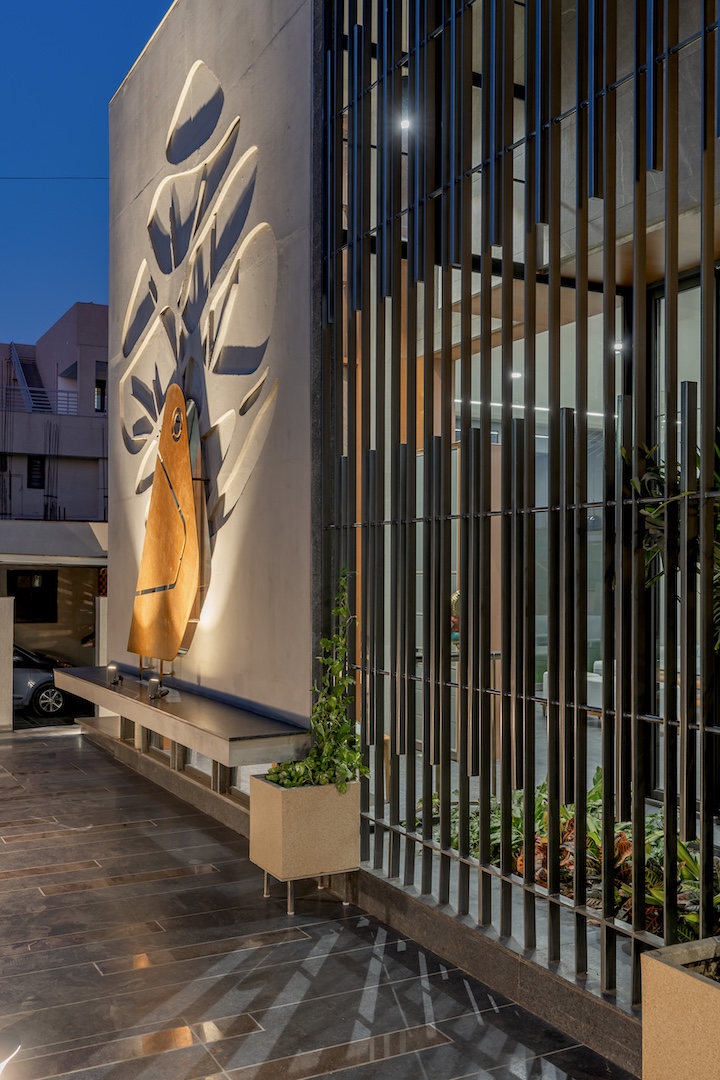
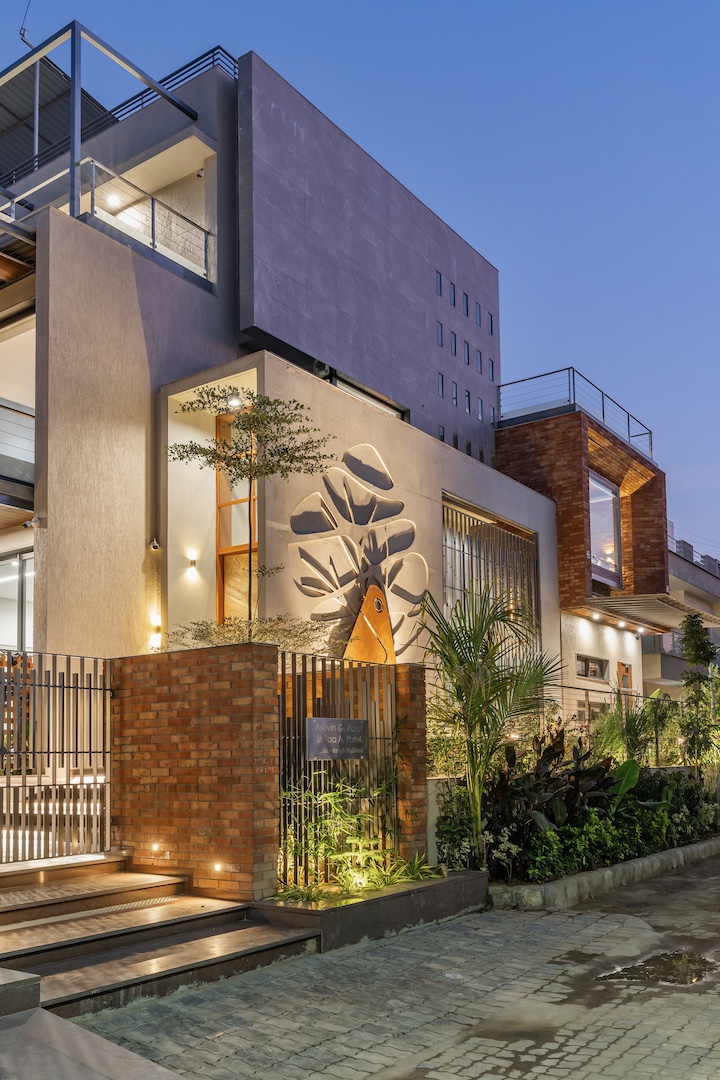
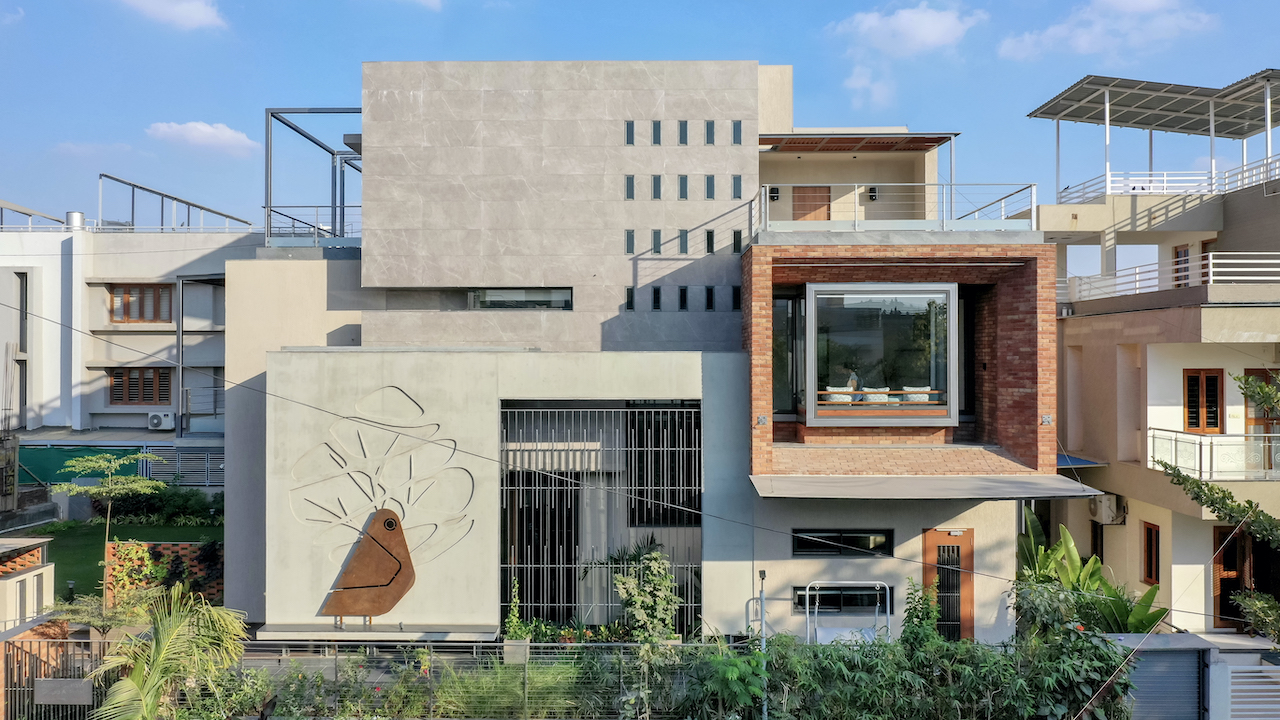 The house gets its name from a cast concrete wall shaped like a tree, paired with a metal sparrow mural, the one real flourish on an otherwise restrained facade. Brick jharokhas break up what would otherwise be a flat elevation. The whole house faces north for the same reason most homes in this climate do: maximum daylight, minimum heat gain. Service areas and courtyards sit toward the south and west, letting in filtered evening light through jaali screens without exposing the living spaces to direct sun.
Inside, the palette stays in beige and grey, with light-coloured furniture throughout. It sounds simple to describe, but restraint is often the harder design decision. It's easy to add detail. It's harder to know when to stop, especially on a custom home where a client might expect more visual "value" for the money. This project worked because every choice was checked against the client's actual taste rather than what looks impressive in a portfolio shot.
31 Atri: A Home Built Around Vastu and a Doctor's Quiet Confidence
This 31 Atri project was personal for us, since it sits in Himatnagar, our hometown. The client was a doctor whose wife held strong Vastu beliefs that shaped almost every planning decision. The plot had its north and east sides open, so the entry was placed exactly at the north-east corner, the most auspicious position by Vastu logic.
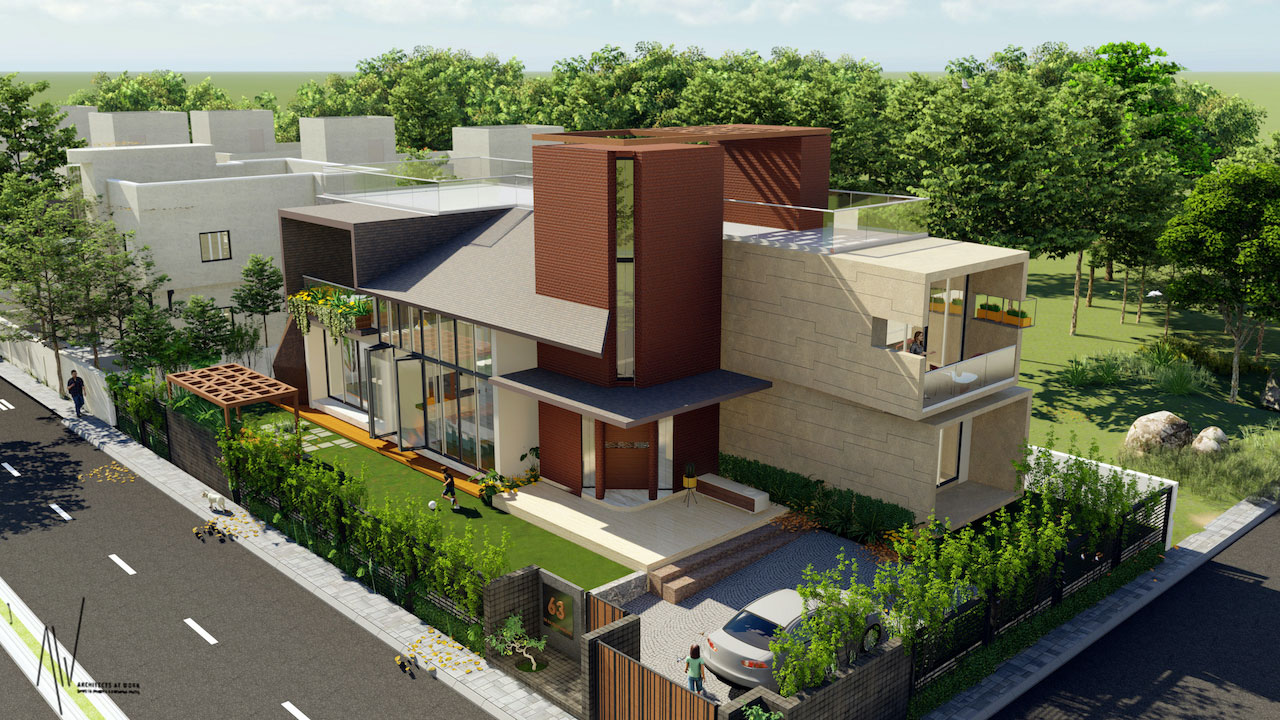
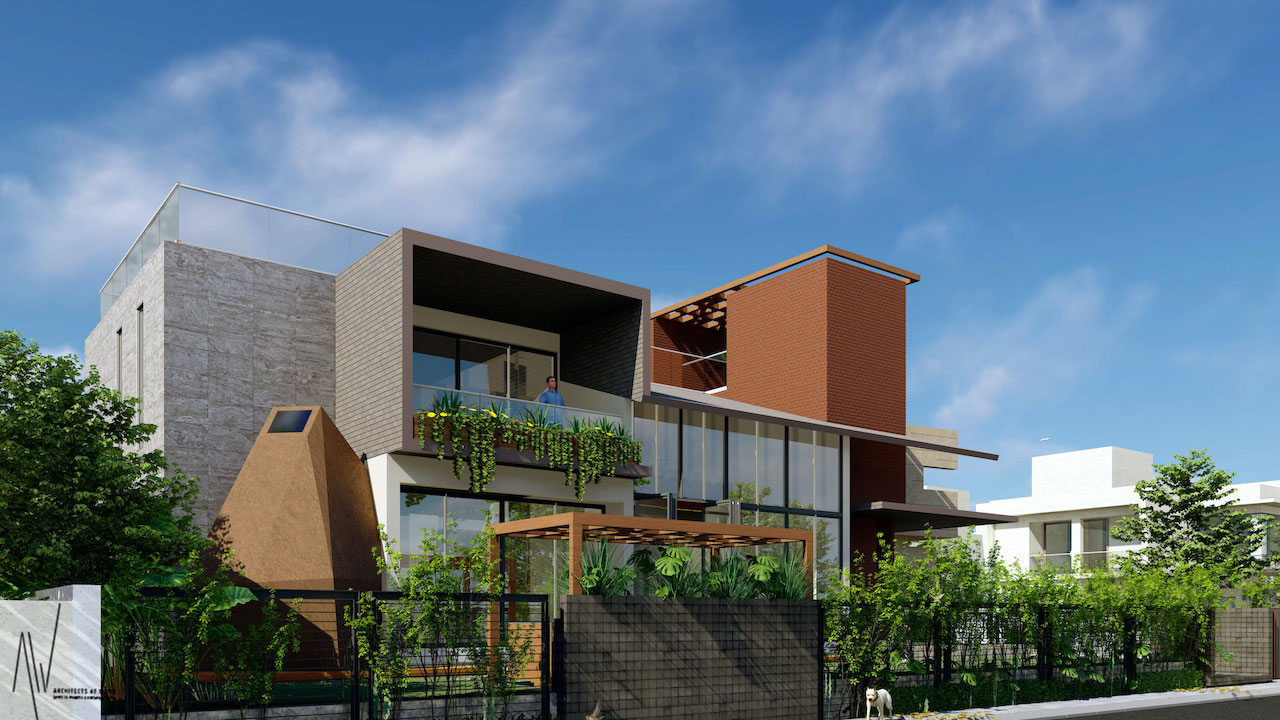
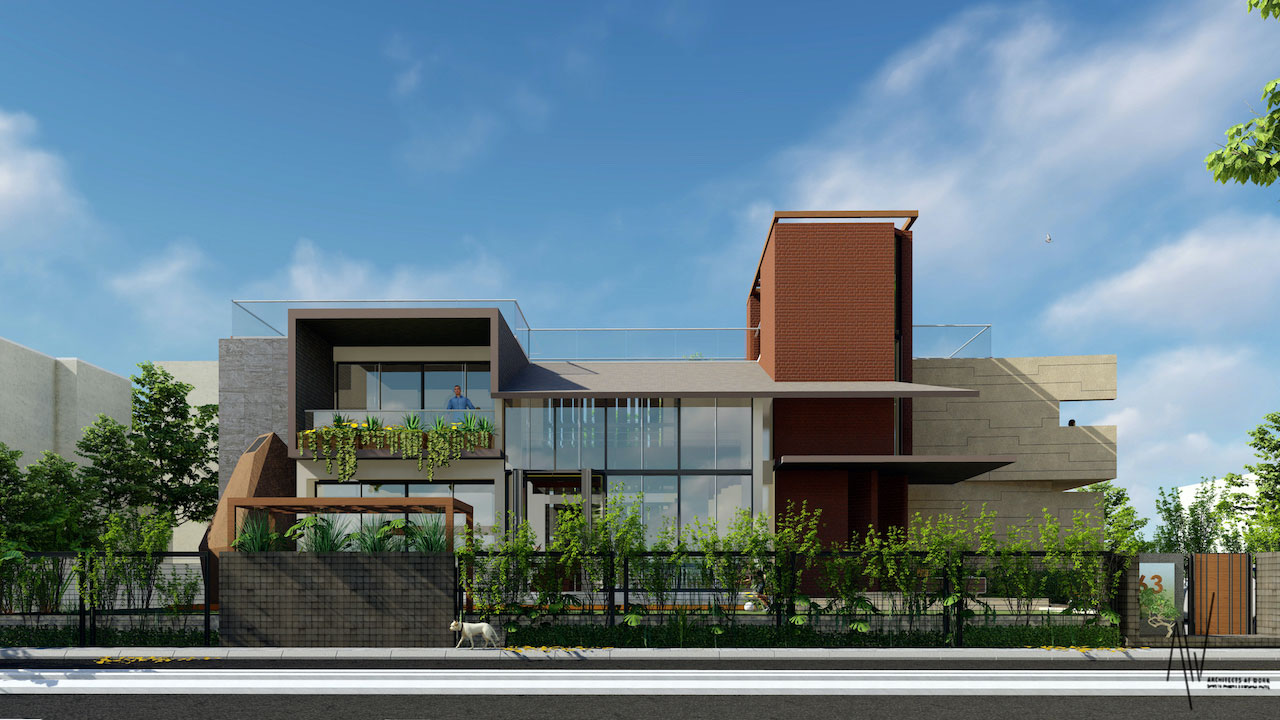
The drawing room and staircase share a slanting roof with a bridge running above it, which gives the elevation an unusual, layered silhouette. From outside, the bedrooms appear slightly skewed against the black facade, a small twist that keeps the building from reading as a flat box. The temple sits in the exact north-east direction too, tucked into a sculptural form that juts out from an otherwise plain wall and lit from above by a skylight that throws shifting shadows through the day. The master bedroom, reached by a bridge, opens into a generous living area and balcony that gives the upper floor its own sense of luxury, separate from the rest of the house.
Hethbandhu: When a Builder-Client Wants His Own Home Done Right
Hethbandhu, a 10,000 sq. ft. residence for Mr Rohit Patel, came with an unusual advantage. The client was an experienced builder himself, and the house was still mid-construction when our team got involved. That meant we could make structural-stage changes most architects rarely get the chance to, introducing a filler slab ceiling and a custom wood-and-metal staircase that became one of the home's centrepieces.
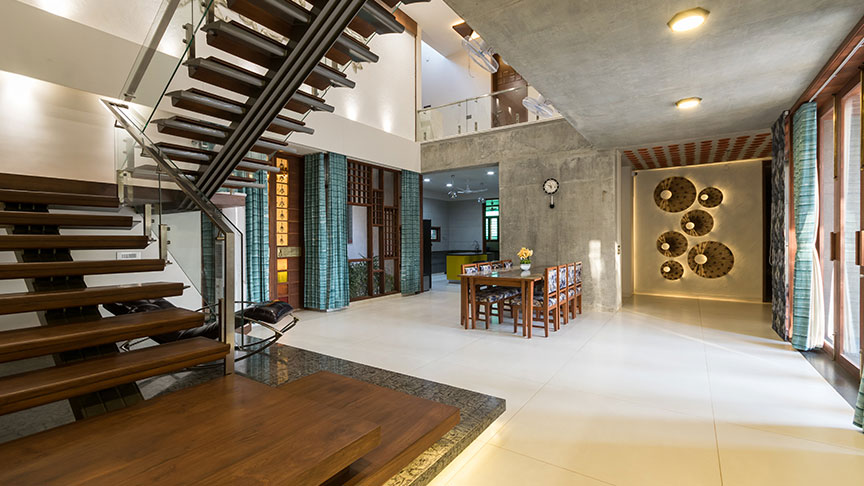
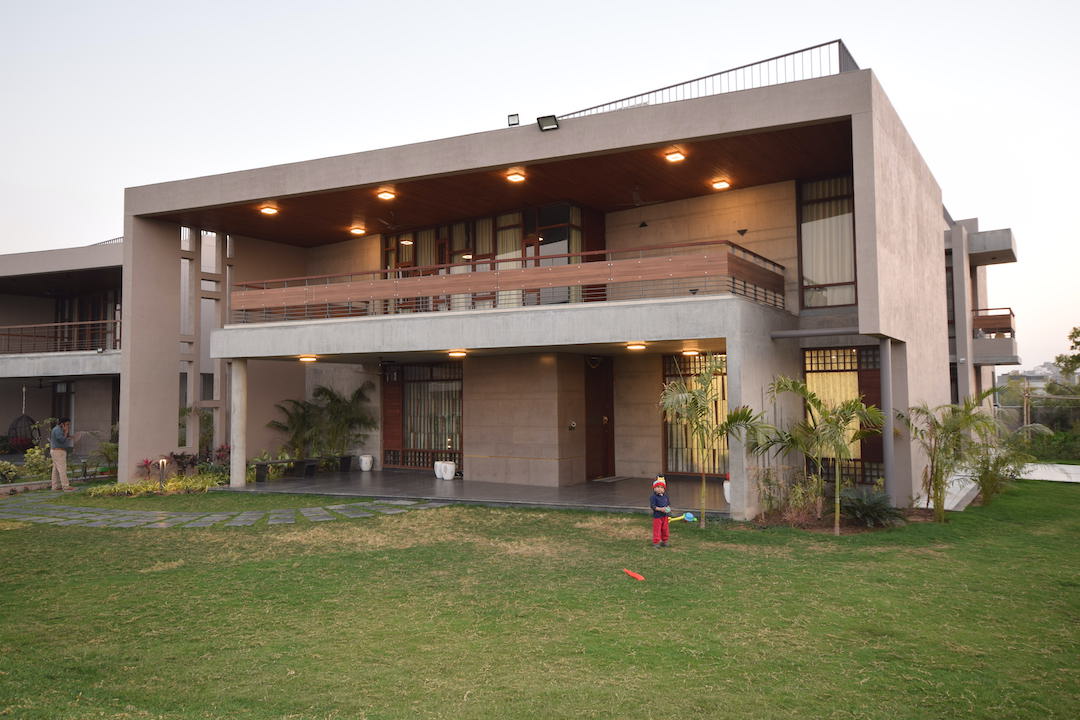
The entrance sets the tone with an embossed wooden mural of Lord Ganesha framed in brass lotus petals. The drawing room carries a hand-painted fish canvas motif, fish being considered favourable for Feng Shui, echoed in an RCC, wood, and steel pattern behind the sofas. The dining area is the most dramatic space in the house: double height, anchored by an eight-seater table sitting directly beneath the staircase, where the wood-and-steel structure crosses overhead.
The pooja room is elliptical in form, lined with Kutch mirror work and hung with bells that chime softly. Each of the five bedrooms across both floors was treated as its own design problem rather than a repeated template. One leans grey and industrial with Italian marble cladding, another stays minimal with hidden storage and a suspended TV unit, and a third uses a deco-style wooden headboard. Refusing to repeat a single bedroom design across a 10,000 sq. ft. home is more work, but it's also what makes a house feel designed rather than assembled from a catalogue.
Swapna Residence: Luxury That Doesn't Need Acreage
Swapna Residence proves that luxury bungalow design in Ahmedabad isn't about how much land you start with, it's about how that land gets used. Built on roughly 600 square yards for Mr Natu Patel, the brief called for individual rooms for every family member, finished to the same high-end standard the client would expect on a far larger plot.
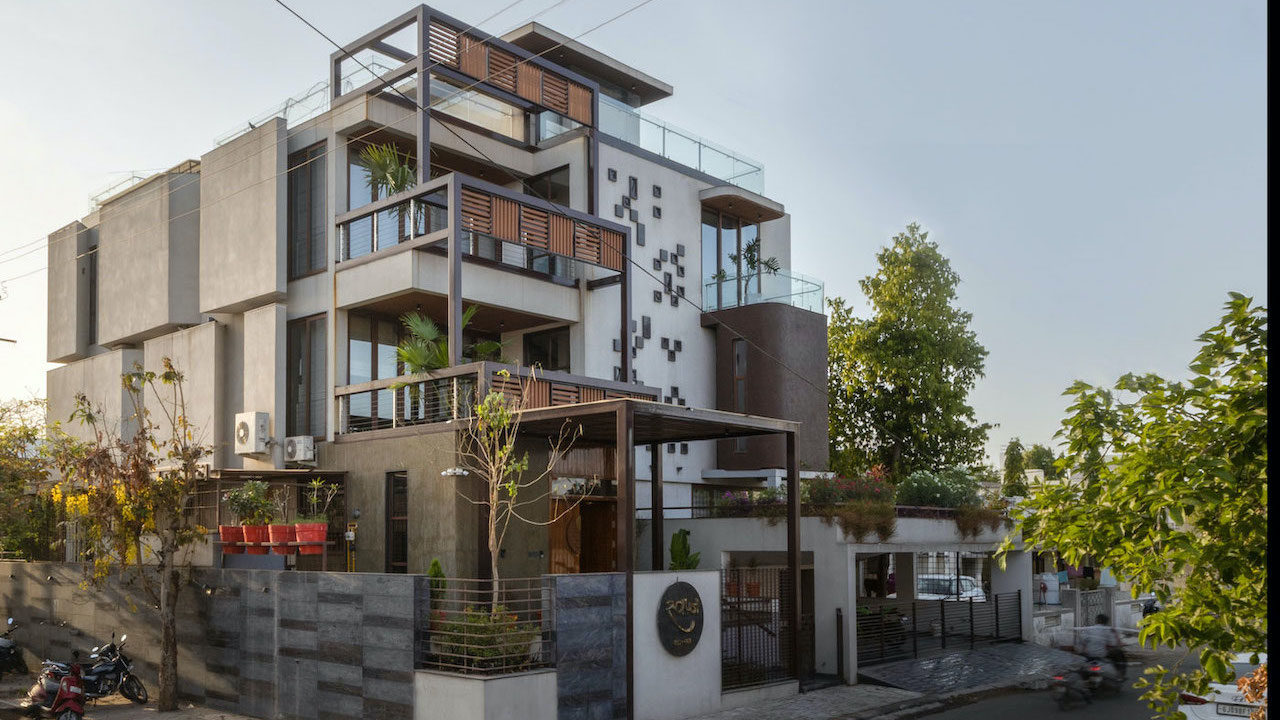
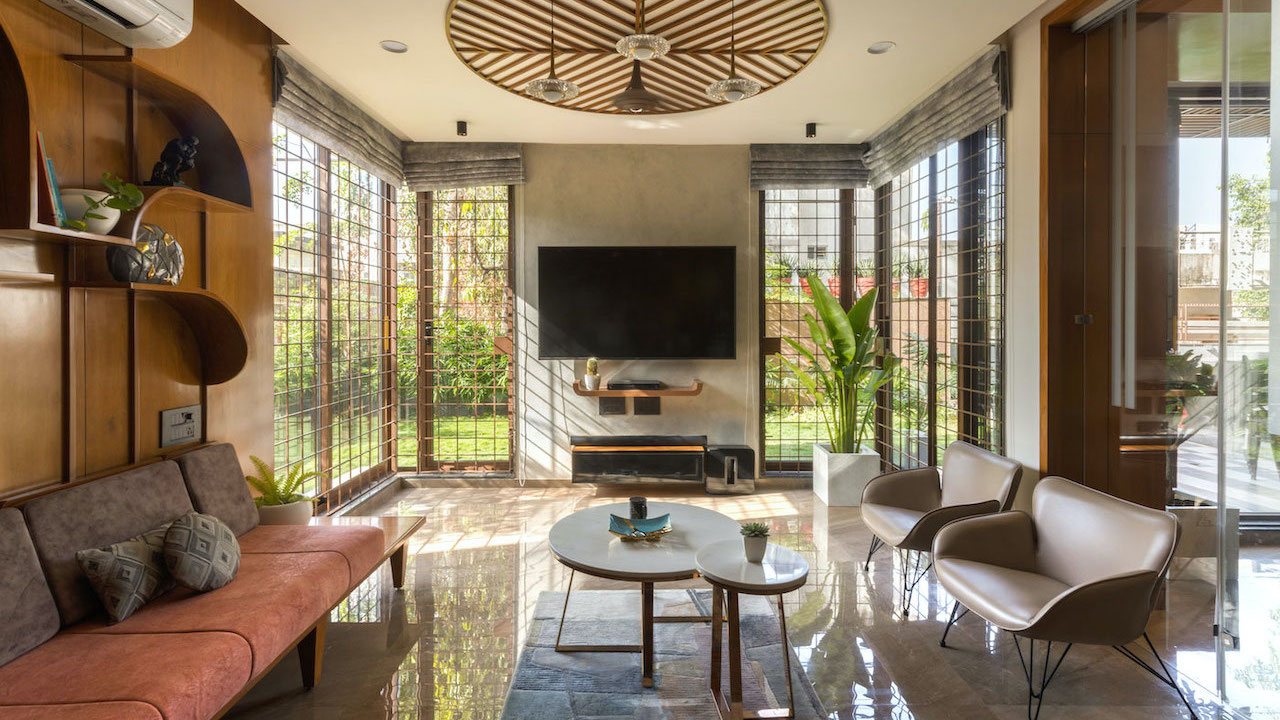
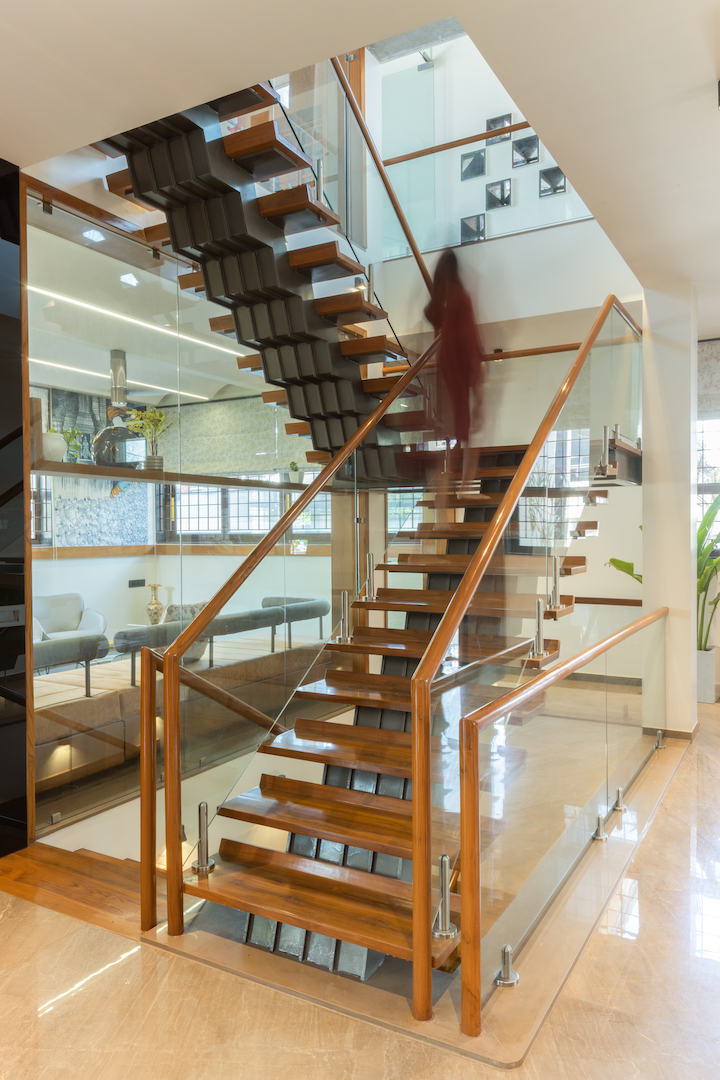
We oriented the house north, with the entrance and main bedroom facing east to catch the morning sun, while living spaces stayed on the north side facing the garden. Toilets and dressing rooms went south, acting as a buffer between the house and the outdoor heat. To get extra usable area, we raised the bungalow's height and added a semi-basement that holds a home theatre. The entry vestibule uses a triangular geometric pattern across the walls, carried through into the powder room door for visual continuity. The dining area's window overlooks the garden under a double-height slab with a bridge crossing above it that connects to a bedroom, while the kitchen sits near the entrance with small openings that let the family glimpse who's arriving without stepping outside. A cantilevered puja unit adds one more distinctive touch to a home where every square foot was treated as premium real estate, regardless of the plot's overall size.
Shyam Niwas
Shyam Niwas is a completed architecture and interior project for Sanjay Agarwal in Jalod, on the eastern edge of Ahmedabad. As with every home in this portfolio, the design started with the plot itself, working out how the site related to the road and the sun before a single wall went up on paper. The finished house carries the same family-first approach we bring to every residence: spaces planned around how the household actually moves through a day, with architecture and interiors handled as one connected scope rather than two separate hand-offs.
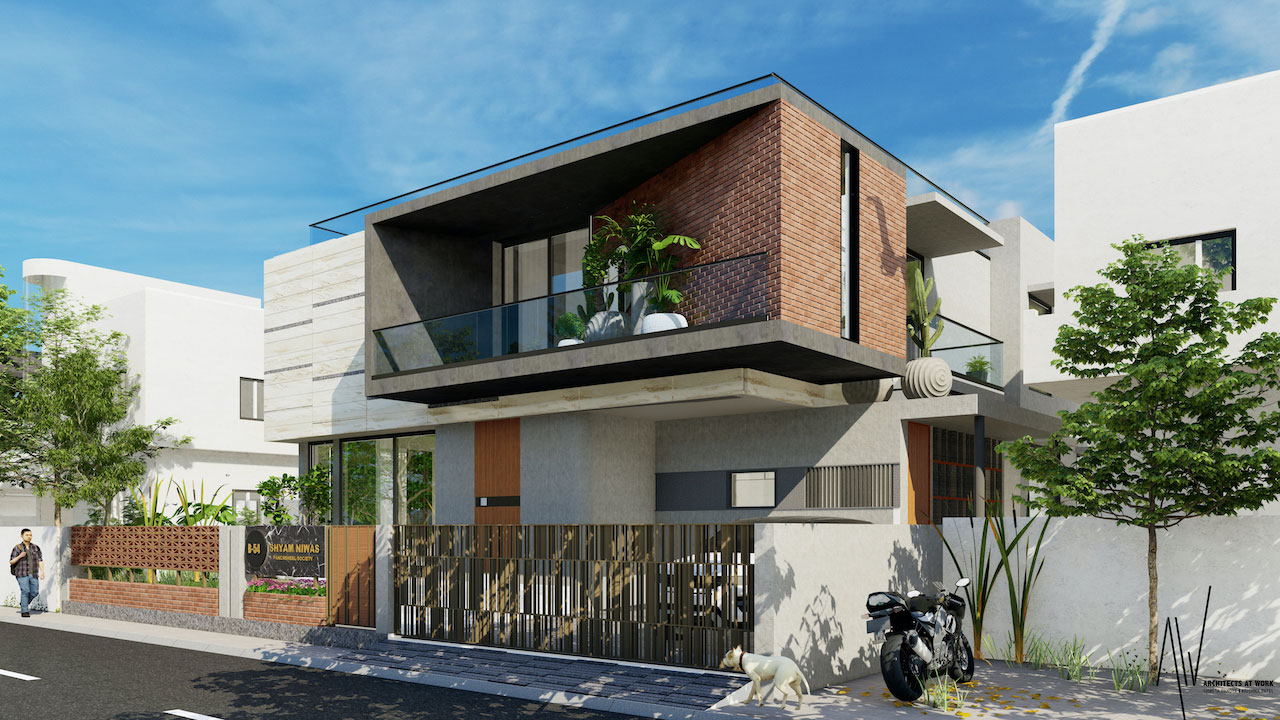
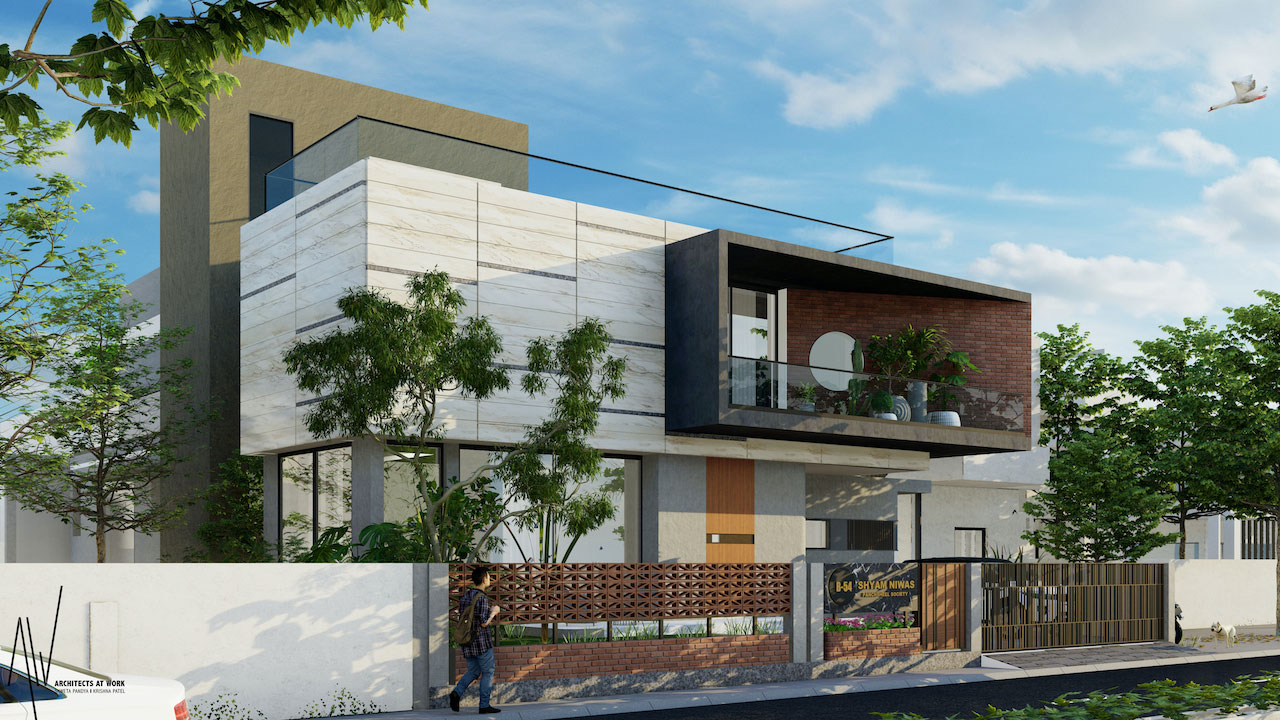
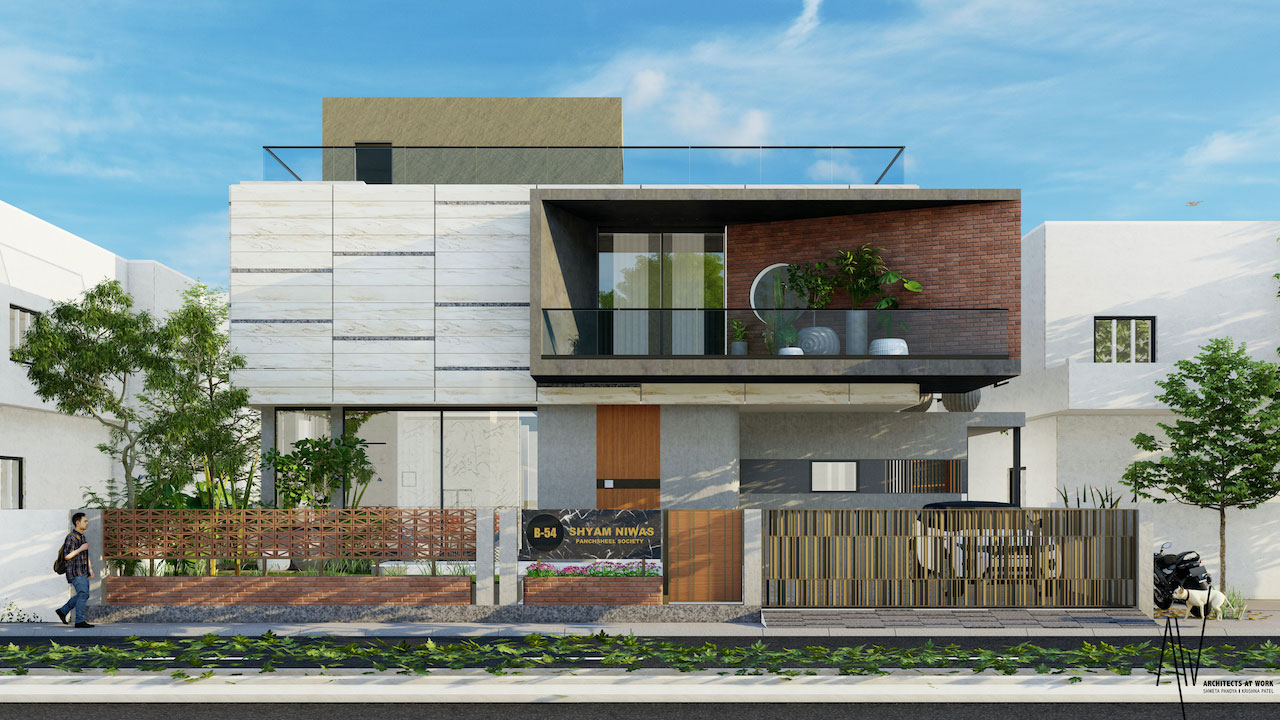
Jalod sits a little further out from the denser pockets of the city, which usually means more breathing room on the plot and fewer neighbouring walls dictating where a window can or can't go. That kind of flexibility tends to show up in how openly the living spaces connect to the outdoors, since there's less need to design defensively around a tightly packed boundary. For a family-focused brief like this one, it's the difference between a home that simply has a garden and one where the garden feels like part of the living space itself.
Billipatra
Billipatra is a 6,000 sq. ft. luxury residence completed for Dr Dharmendra Agrawal. At this scale, the planning conversation usually centres on giving a family enough genuinely private zones, individual bedrooms, dressing areas, a dedicated puja space, without the house losing the openness that separates a bungalow from an apartment stacked with rooms. That balance between privacy and openness, and between custom detailing and restraint, runs through the finished home the same way it does on The Concrete Tree and 31 Dagli's.
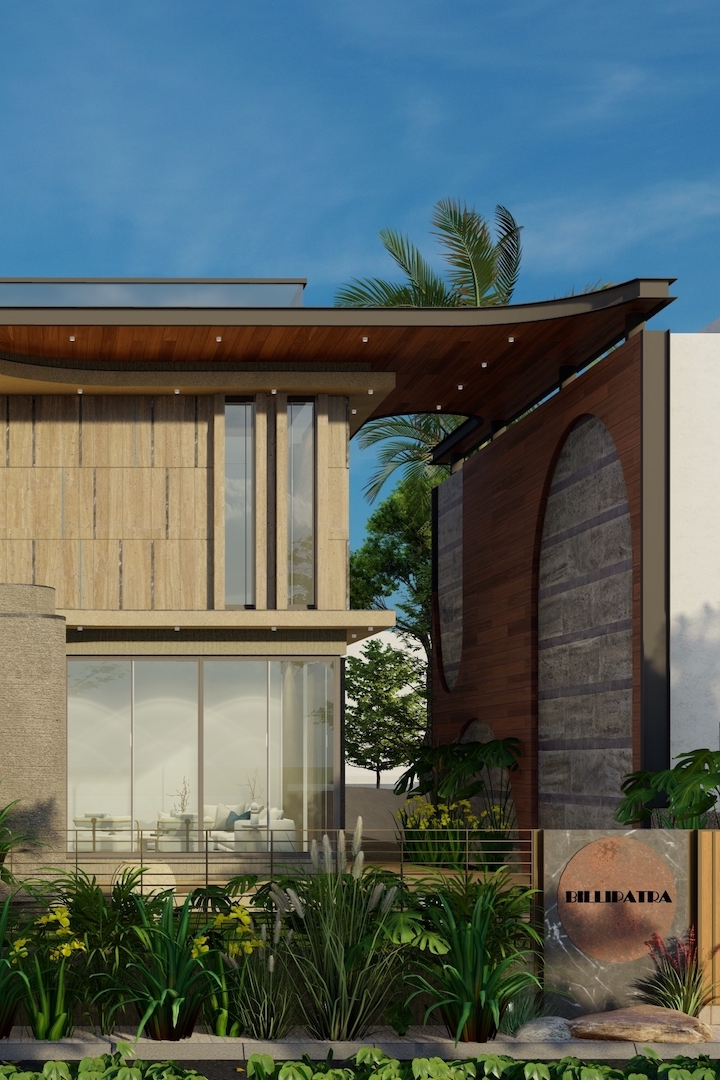
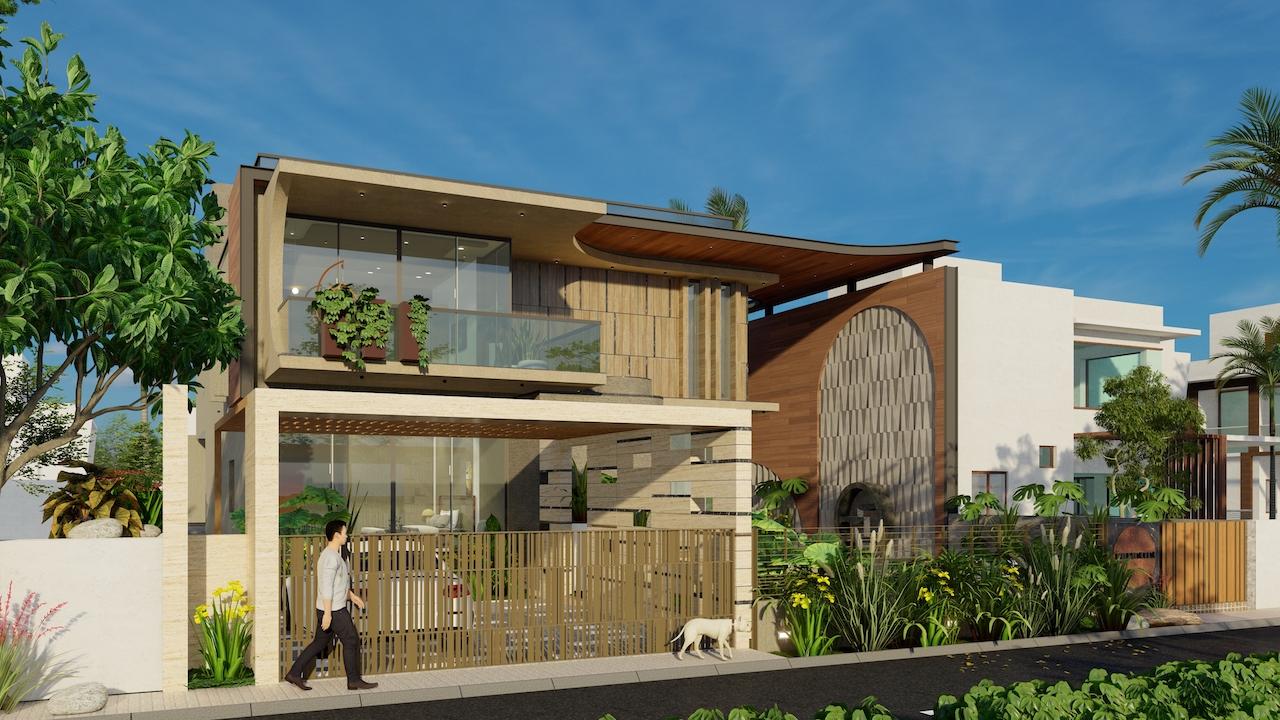
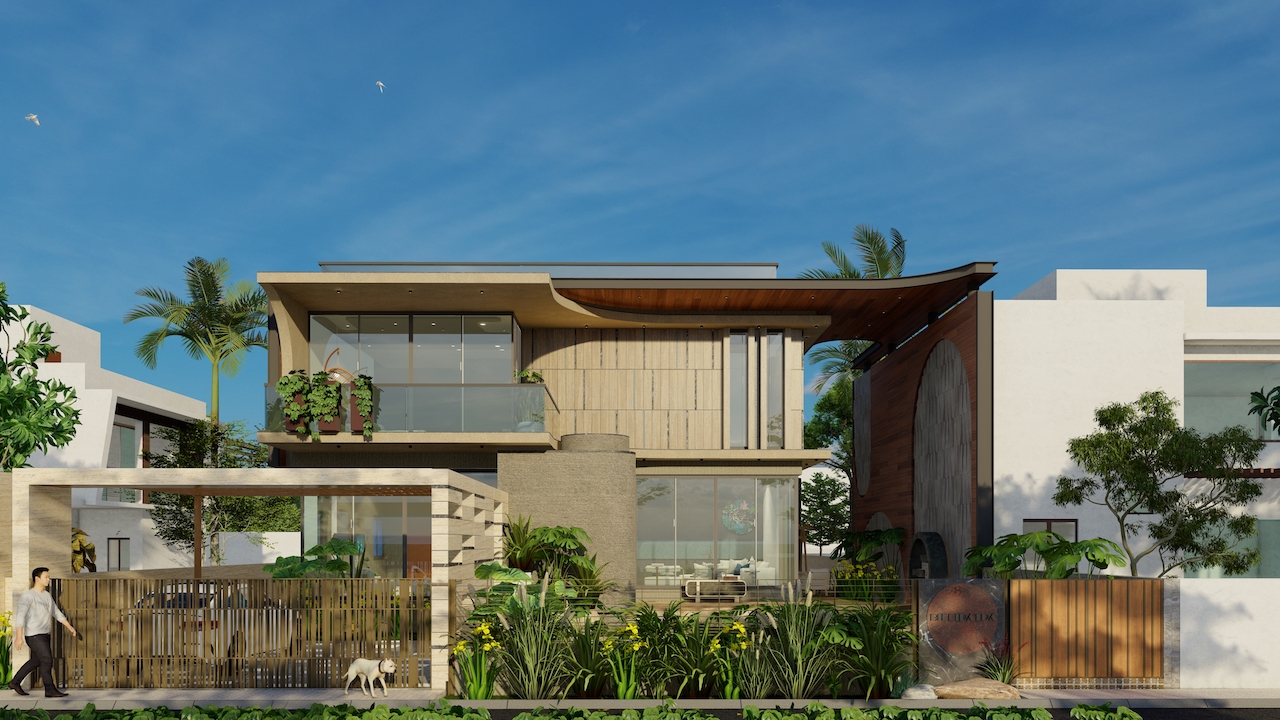
A home in this range, built for a single household rather than a sprawling joint family, usually has more room to dedicate to one or two genuinely show-stopping spaces instead of spreading the design budget thin across every corner. It's also the size at which a separate guest wing or an independent floor for parents becomes realistic without crowding the rest of the plan, giving the house room to grow with the family over time rather than feeling fixed the day it's handed over.
347 Otherside
At 13,000 sq. ft., 347 Otherside is one of the largest homes in our portfolio, completed for Pragneshbhai Shah. A plot this size opens up possibilities a smaller home can't accommodate: distinct zones for different generations under one roof, generous circulation, and enough room for landscape and water features to function as genuine architectural elements rather than an afterthought near the gate. It stands today as one of our flagship large-format residences.
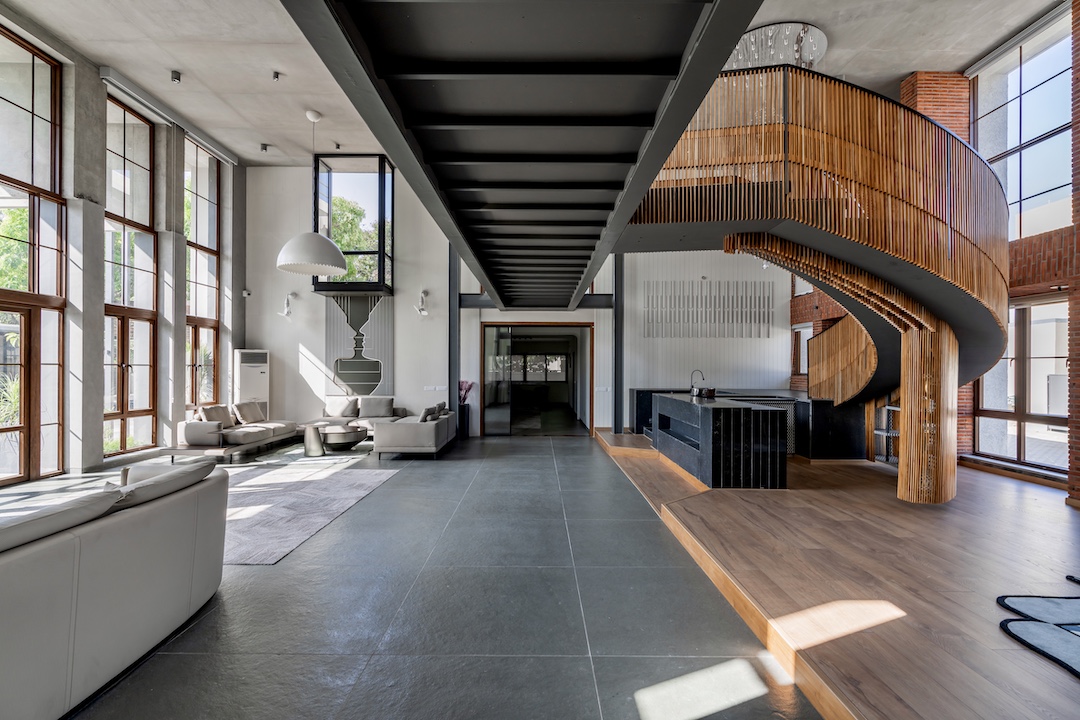
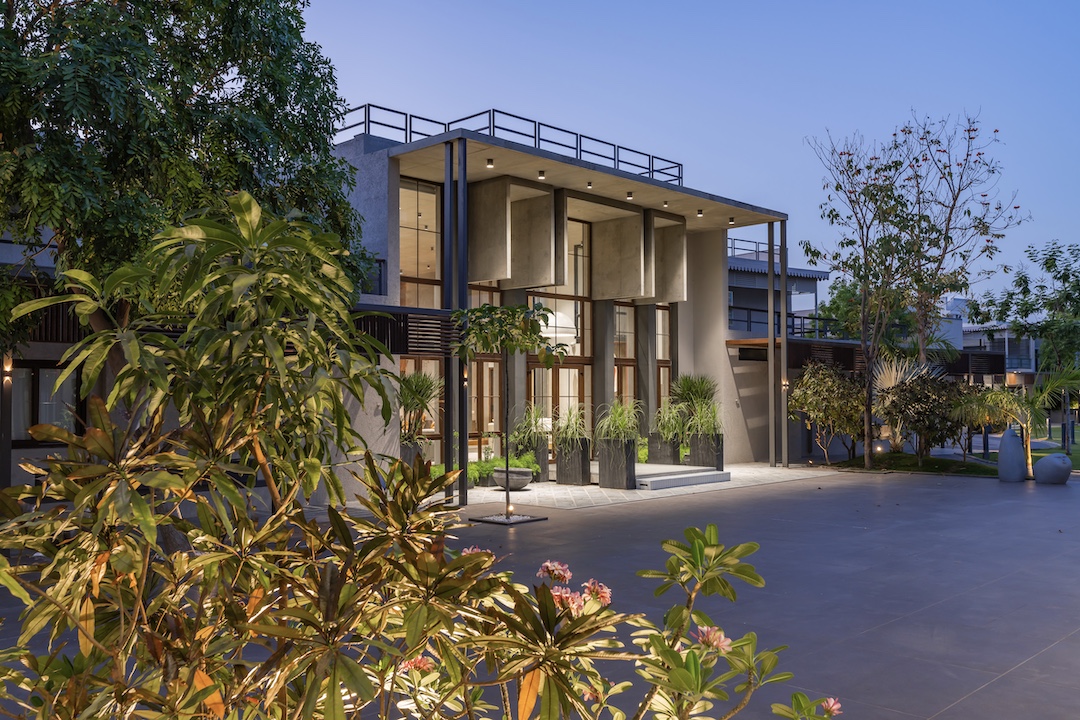
At this scale, the conversation shifts from where things go to how far apart they can comfortably sit. Service areas, guest zones, and family-only wings can each claim their own clear territory instead of brushing up against each other, and a facade this long has room to work with rhythm and repetition rather than relying on a single dramatic gesture to carry the whole elevation. Landscaping stops being an edge condition at this point and becomes a structuring layer in its own right, threading the different zones of the house together.
What These Projects Have in Common
Look across all eight projects and a few threads repeat. North orientation shows up again and again, not because it's trendy but because it's the only sane response to Ahmedabad's sun. Jaalis, jharokhas, and courtyards aren't decoration, they're how older Gujarati building wisdom gets translated into a present-day home without it feeling like a museum piece. And almost every project treats interiors as inseparable from the architecture rather than as a phase that happens after the structure goes up.
That last point is why working with a single firm across both ends matters. A good bungalow interior designer in Ahmedabad needs to understand why a wall is where it is, and why a window got placed at that exact height, before deciding what goes on top of it. When the same team designs the shell, the temple jaali, the staircase, and the headboard detailing, the house reads as one continuous idea instead of a structure with furniture dropped into it afterward. That's the difference between hiring bungalow architects in Ahmedabad who treat interiors as someone else's problem, and a firm that carries the same design language from the front gate to the last cupboard handle.
What Does Luxury Bungalow Design in Ahmedabad Actually Cost?
This is usually the first question clients ask, and fair enough. Bungalow architects in Ahmedabad generally work on one of three fee models: a percentage of construction cost, a per-square-foot rate, or a fixed lump sum for tightly defined scopes. For 2026, per-square-foot fees in the market typically range between ₹200 and ₹500 per sq. ft., with high-end firms with a strong track record sitting toward the top of that band or working on a percentage basis instead, usually around 15% of construction cost for larger residences. Because we work exclusively on fully custom, high-end bungalows, our own engagements are almost always structured around the percentage or upper-band per-square-foot model, covering architecture, interiors, and site supervision together rather than as fragmented add-ons. Location plays a role too: premium pockets like Bopal, Shela, Prahlad Nagar, and SG Highway come with stricter AMC/AUDA compliance and higher material expectations, which is reflected in the fee. Detailed interior design, with custom furniture, material procurement, and project management, is typically billed at ₹150 to ₹300 per sq. ft. on top of the architectural fee when scoped separately. None of these numbers are fixed in stone. A 10,000 sq. ft. home like Hethbandhu, with mid-construction structural changes and bespoke interior detailing throughout, sits in a different cost bracket than a fully custom 600-yard home like Swapna Residence, even though both were delivered to the same uncompromising standard. The honest answer is that final cost depends on scale, design complexity, plot location, and how much of the interior is bespoke.
Frequently Asked Questions
Who are the best bungalow architects in Ahmedabad?
The strongest firms aren't necessarily the biggest ones, they're the ones with a portfolio you can actually walk through project by project, not just a gallery of pretty renders. Look for Council of Architecture registration, a track record across multiple luxury bungalows rather than one lucky hit, and a team willing to step into a project mid-construction and make structural changes when it genuinely improves the home, the way we did on Hethbandhu. A firm that handles architecture, interiors, and site supervision under one roof, rather than handing you off between three different vendors, tends to deliver a more coherent final house.
What are some modern bungalow design ideas suited to Ahmedabad's climate?
North orientation for the main living spaces is the single biggest lever, since it gives daylight without direct heat gain through most of the day. Beyond that, deep chajjas and overhangs on the south and west facades, cavity walls or filler slab roofs for thermal insulation, and jaali or jharokha screens that filter light into service areas all show up repeatedly in our work, from the brick jharokhas at The Concrete Tree to the cavity-wall south facade at 31 Dagli's. Courtyards placed near the kitchen, dining, or temple area also bring in ventilation and shifting light without compromising privacy.
How do I find a luxury bungalow construction company near me in Ahmedabad?
Worth clarifying first: an architecture and interior design firm and a pure construction contractor aren't the same thing, even though both get searched under similar terms. A construction-only company executes drawings handed to them. A full-service luxury design firm develops the architecture, the interiors, and then oversees construction quality through regular site supervision, which matters far more on a high-end home where finish tolerances are tighter and materials are custom. When evaluating anyone local, ask for a detailed Bill of Quantities, confirm who personally visits site and how often, and check whether interior detailing is handled by the same team that designed the structure.
How much does it cost to build a 3BHK bungalow in Ahmedabad?
This depends heavily on built-up area and finish level, so treat any number as a planning band rather than a quote. A luxury 3BHK independent bungalow typically runs somewhere between 2,200 and 3,000 sq. ft. of built-up area. Several Ahmedabad-specific cost calculators in 2026 put premium and luxury-grade construction, excluding land, architect fees, and interiors, somewhere in the ₹1,800 to ₹2,300 per sq. ft. range for standard quality, climbing past ₹4,000 per sq. ft. for premium finishes, while other local estimators place luxury-grade work closer to ₹3,000 to ₹3,500 per sq. ft. and above. Using a working figure of roughly ₹3,000 to ₹4,000 per sq. ft. for high-end construction, a 2,500 sq. ft. luxury 3BHK lands somewhere between ₹75 lakh and ₹1 crore for the structure alone. On top of that, factor in the architect's design fee, typically a percentage of construction cost or a per-square-foot rate at the upper end of the market, plus a separate interior design budget if you want full custom detailing rather than standard finishes. A proper BOQ from your architect, not a generic online calculator, is the only way to get a number you can actually plan around.
Who are the top-rated bungalow interior designers in Ahmedabad?
The ones worth shortlisting are the ones who treat every room as its own design brief instead of repeating a template across the house. At Hethbandhu, for example, none of the five bedrooms share a finish palette, each was built around the personality of the person living in it. That level of customization, paired with the ability to read structural drawings and know exactly where a headboard, a wardrobe, or a TV unit can sit without fighting the architecture underneath, is what separates a strong interior designer from someone who's just good at picking fabrics.
What are the top architectural firms for residential projects in Ahmedabad?
Rather than chasing a "top firms" list, it's more useful to evaluate firms against a few concrete criteria: COA registration, a portfolio that spans different plot sizes and briefs rather than one repeated formula, transparent payment milestones, and clarity on who will actually be your day-to-day point of contact once the project starts. A firm willing to show you completed homes across a real range, from an intimate 600-yard plot to a 13,000 sq. ft. estate, gives you a more honest read on capability than one polished hero project ever can.
What are sustainable materials worth considering for bungalow construction in Gujarat?
Exposed RCC and filler slab roofs reduce both material use and visual clutter, and we've used both as design features rather than hiding them, as seen at Hethbandhu. AAC blocks are increasingly common across Gujarat for exterior walls because they're lighter, which reduces seismic load, and offer noticeably better thermal insulation against the region's summer heat. Locally sourced stone, including sandstone and material from nearby Rajasthan quarries, cuts down on transport emissions compared to imported finishes while still delivering a premium look. Fly ash bricks and locally produced cement and steel, both readily available in Gujarat, round out a build that's lower-impact without compromising on quality.
What are some eco-friendly bungalow design ideas suited to Ahmedabad's climate?
Passive cooling does most of the heavy lifting here. North-facing living areas, courtyards that pull cross-ventilation through the house, and deep chajjas on the south and west facades all reduce dependence on air conditioning before a single sustainability feature gets added. Heat-reflective or cool-roof coatings on the terrace, double-glazed or low-E glass on west-facing windows, and rainwater harvesting tied into landscaping are practical additions on top of that. Solar panels on the terrace are increasingly common on larger plots where roof area allows for it.
What are good interior design concepts for a bungalow on a smaller plot?
Smaller doesn't have to mean simpler. On Swapna Residence, built on roughly 600 square yards, we got the individual-room brief to work by going vertical, adding a semi-basement for the home theatre, using a double-height dining volume with a connecting bridge, and treating the entry vestibule's triangular pattern as a unifying motif carried through into the powder room door. The principle that scales down well from larger homes is visual continuity: one strong material or pattern language repeated with intent across a few key spaces reads as far more considered, and far more luxurious, than five unrelated design ideas competing for attention in a smaller footprint.
Every one of these homes started with the same basic problem: a plot, a family, a climate that doesn't forgive bad orientation, and an investment that has to be allocated across structure and interiors both. The solutions look different because the families are different, and that's really the point. Good luxury bungalow design in Ahmedabad isn't about a signature style stamped on every project. It's about a process that pays close enough attention to a specific plot and a specific family to find what that one house actually needs, with no shortcuts anywhere along the way.
If you're planning a high-end bungalow project in Ahmedabad and want a team that handles architecture and interiors as one continuous conversation rather than two separate hires, we'd be glad to talk through your plot and your brief.
